The Enterprise Solution Architecture
How Neon AI Factory Architect fits into the AI Factory delivery pipeline
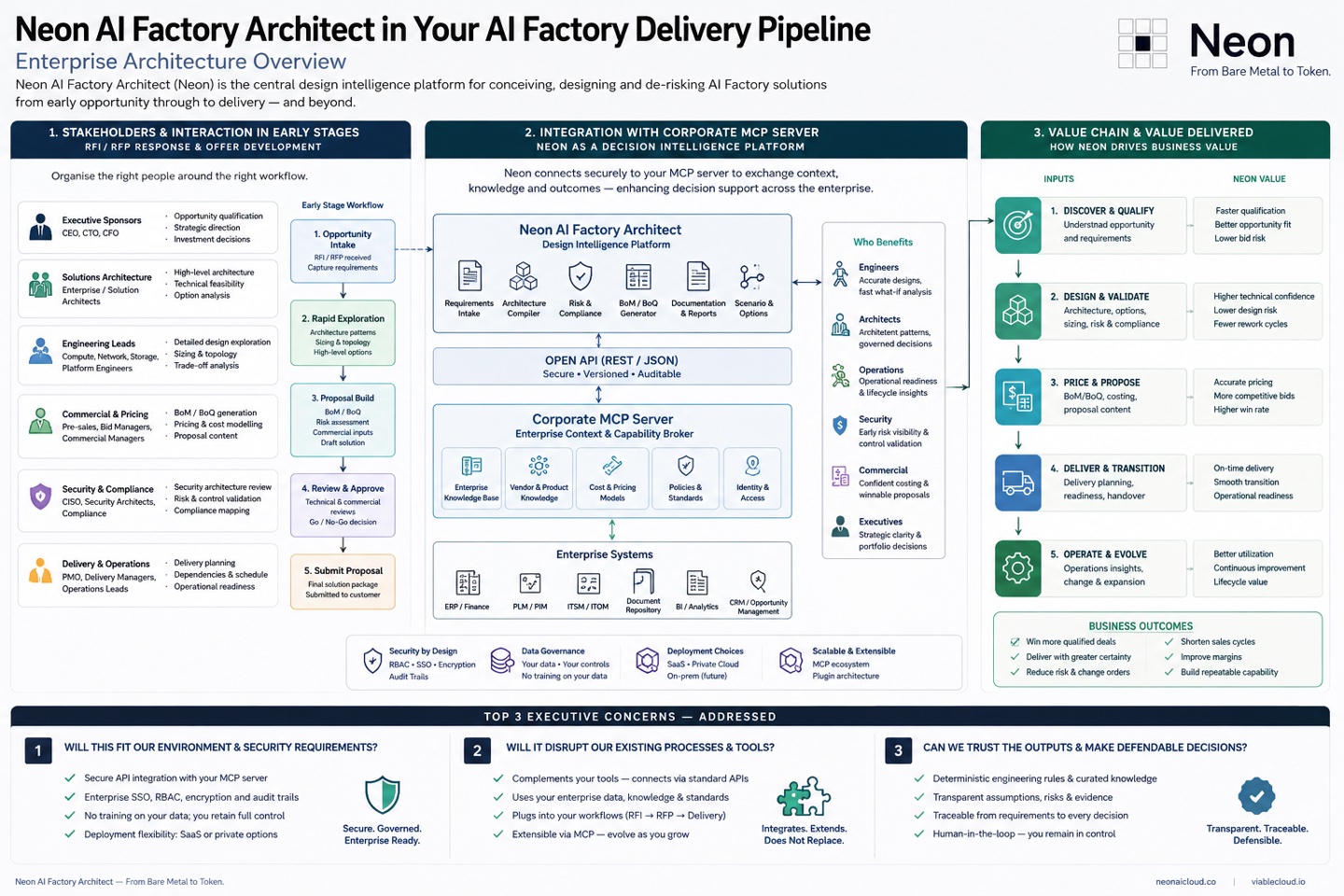
AI Factory projects rarely fail because one team cannot design a GPU cluster.
They fail because the design has to cross too many organizational boundaries:
- Sales needs something credible enough to take to market.
- Architects need something technically defensible.
- Engineering needs something buildable.
- Security needs something they can assure against compromise.
- Procurement needs something that can be sourced.
- Delivery needs something that can actually be executed.
Those groups often work from different tools, different assumptions, and different versions of the truth.
Neon AI Factory Architect is designed to sit in the middle of that problem.
Its role is not to replace the surrounding enterprise systems or the people who operate them. Its role is to become the governed architecture and decision-support layer that converts customer demand into a coherent AI Factory design solution before that solution is committed into pricing, procurement, contracts and delivery.
From Bare Metal to Tokens.
Start where the risk is still cheap
The most valuable point to use Neon is early.
A typical AI Factory opportunity begins with an RFI, an RFP, a set of customer requirements, or even just a commercial idea that needs to be turned into an offer.
At that stage, most important decisions are still reversible.
The customer may know how many GPUs they want, but not what fabric is appropriate. They may have a preferred storage vendor but no validated topology. They may have a delivery date but no credible deployment sequence. They may have commercial pressure to submit quickly while several technical assumptions remain unresolved.
That is exactly where a structured architecture process creates leverage.
The recommended operating model is a cross-functional architecture cell built around the opportunity:
- Sales and commercial teams bring customer requirements and business constraints.
- The lead solution architect owns the Neon project and turns those inputs into an architectural baseline.
- Network, compute, storage, platform and data-centre specialists review the relevant parts of the design.
- Security and compliance teams validate trust boundaries, control assumptions and unresolved risks.
- Procurement and delivery teams assess whether the design can be sourced and executed.
- Executives make the decisions that matter.
The important distinction is that these teams should not independently create competing versions of the architecture.
They should collaborate around one governed design.
A practical early-stage flow looks like this:
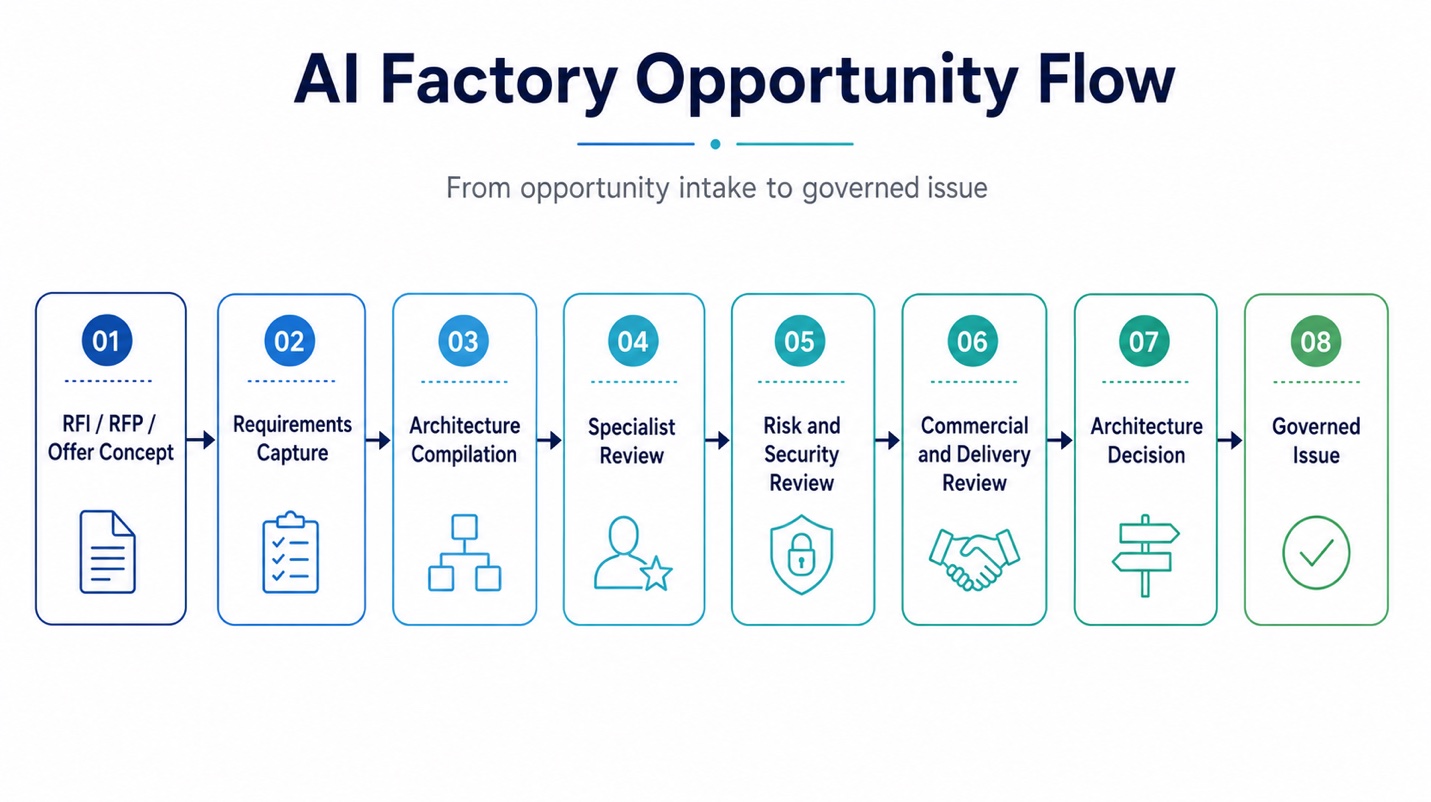
The lead architect remains accountable for the solution.
Neon provides the integrated machinery to keep the surrounding reasoning, assumptions, evidence and outputs aligned.
Neon owns architecture truth, not enterprise truth
Introducing a new platform into an enterprise immediately raises a reasonable question:
Does this create another system of record?
The answer should be precise.
Neon should become the system of record for AI Factory architecture state, at least during the early development stages past customer acceptance.
That includes things such as:
- Interpreted requirements and validated requirements
- Selected architecture among alternatives
- Design assumptions
- Key architecture decisions
- Validated technical alternatives
- Reviewed architecture risks
- Requirements traceability
- Solution projections
It should not attempt to replace systems that already own other enterprise domains:
- CRM should still own the customer and opportunity.
- ERP should still own commercial and procurement transactions.
- Project-management systems should still own delivery execution.
- IAM should still own identity.
- Document-management systems should still own enterprise records.
- CMDB, PLM or asset-management platforms should still own operational configuration where appropriate.
That boundary is important because Neon is most valuable when it becomes the place where architecture is governed, without trying to become the place where everything is governed.
Neon’s response to agentic AI — where MCP changes the picture
The more interesting enterprise opportunity appears when Neon is connected to a corporate MCP environment.
Many organizations are now building internal AI assistants, engineering copilots and agentic workflows that need controlled access to enterprise systems.
A corporate MCP server can become the orchestration layer through which those assistants interact with Neon.
The architectural pattern is simple:
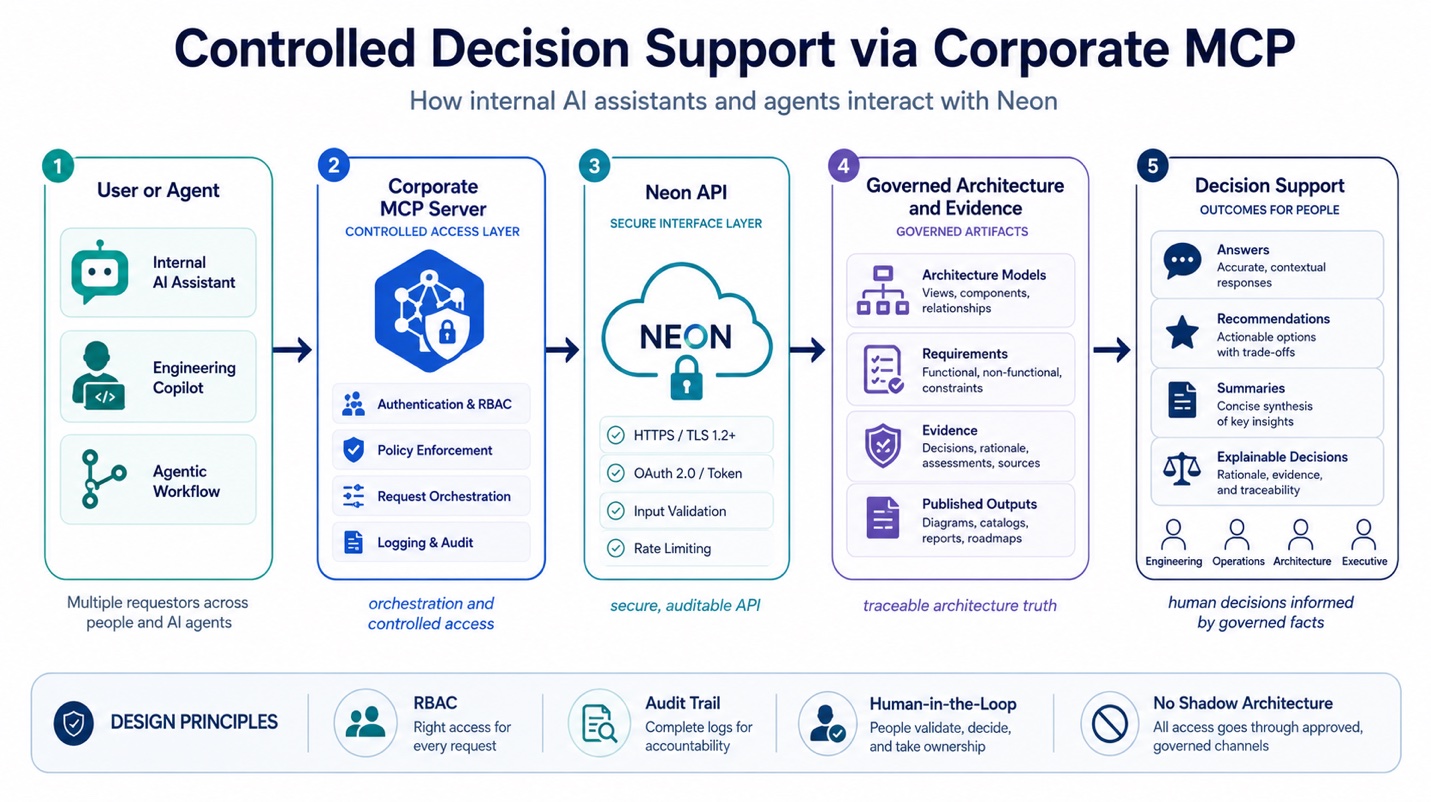
This enables a new way of consuming and actioning architecture information — living architecture or architecture in motion.
An engineer could ask:
“What east-west fabric is selected for this project, and what assumptions drove the choice?”
A procurement user could ask:
“Which products are selected architecture bases, which are valid alternatives, and which still require evidence?”
An operations engineer could ask:
“Which design assumptions must be validated before handover?”
A CTO could ask:
“What are the top unresolved architecture risks in this opportunity?”
A CISO could ask:
“Which trust boundaries and control assumptions are associated with the current design?”
The value is not simply in having conversations about the architecture on the office floor. The value is that the answer can come from the same governed architecture platform that generated the solution documents.
In this sense, Neon offers a strong enterprise decision-support capability where architecture is directly linked to the engineering, logistics, security and operational teams dealing with the consequences of architecture.
Neon’s developer API and ability to integrate with corporate MCPs enable this transformational capability.
Where Neon creates value in the AI Factory business
The easiest way to understand Neon commercially is to look at the AI Factory builder’s value chain.
A simplified value chain looks like this:
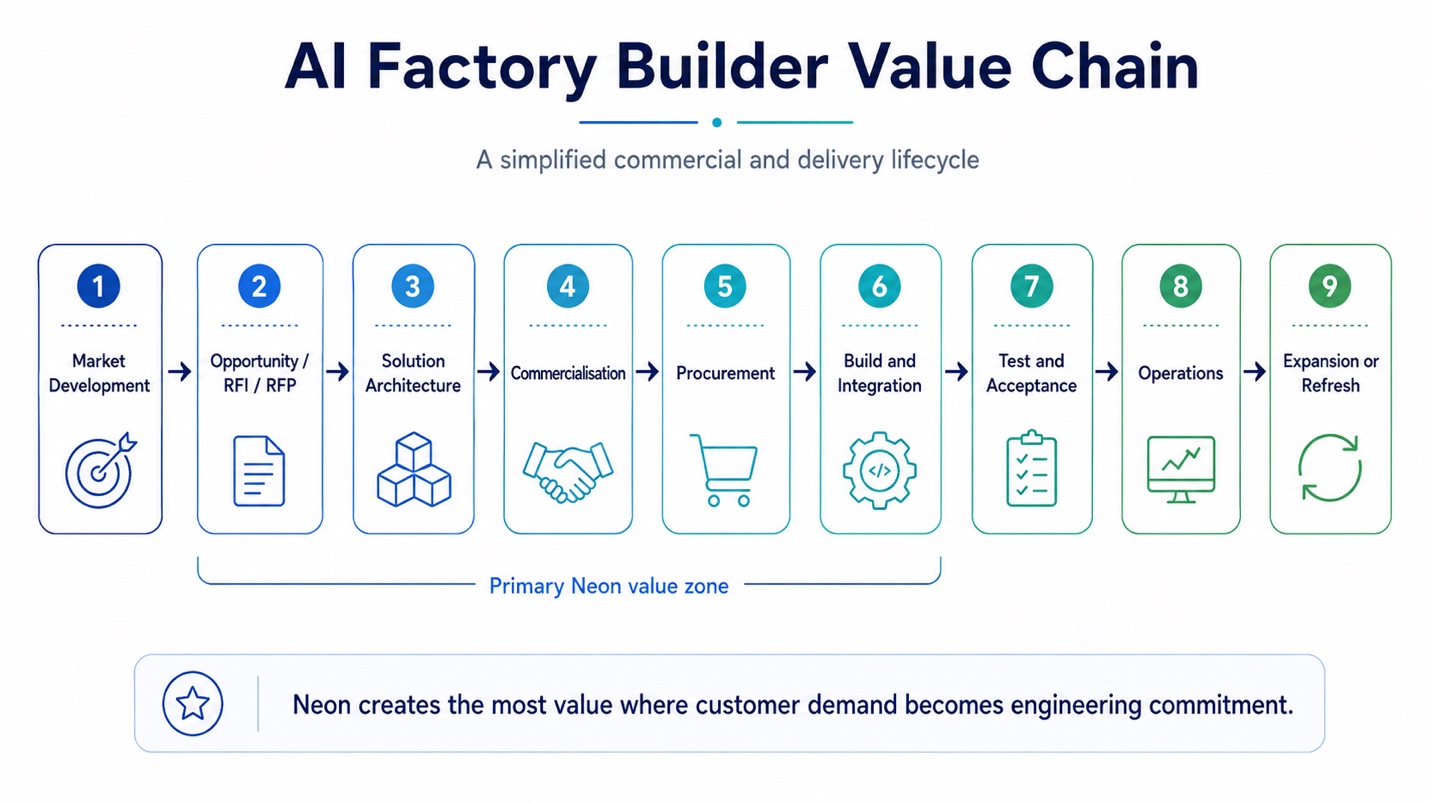
Neon creates most of its value from the point where an opportunity becomes technically serious through to the point where the architecture is handed into execution.
- During opportunity development, it can help expose missing requirements and contradictory assumptions earlier.
- During architecture, it can improve consistency across compute, fabric, storage, management, security and deployment concerns.
- During commercialisation, it can produce a stronger technical basis for pricing and scope.
- During procurement, it can make product choices and architecture dependencies clearer.
- During delivery, it can provide a more controlled handover from the people who designed the solution to the people who have to build it.
- During operations and later expansion, the governed architecture can remain a useful reference for understanding what was intended and how a proposed change affects the wider system.
This is why the value proposition is broader than architecture productivity. Neon acts as a risk-compression layer between sales objectives and capital commitment.
The three questions executives ask
1. Will this disrupt our existing tools and processes?
It should not. The right model is integration, not replacement.
Neon should plug into the existing enterprise environment through APIs and the corporate MCP layer, while remaining bounded to the architecture domain.
The architecture team gains a governed design system without forcing CRM, ERP, project, identity or operational systems to change ownership.
2. Does this create an AI governance or security problem?
Neon AI Factory’s integration into your AI Factory pipeline should preserve existing controls.
Enterprise identity, RBAC, audit, approval boundaries, revision control and authority separation should remain intact.
The MCP layer should provide controlled access to Neon, not a bypass around it.
This gives the enterprise the benefits of conversational and agentic access without turning the LLM into an uncontrolled architecture authority.
3. Where is the economic value?
Not in drawing diagrams faster.
Neon reduces the time and risk between capturing an AI Factory opportunity and a customer commitment.
The value comes from:
- Faster bid development due to rapid, holistic architecture solutions based on actual AI Factory designs
- Better use of scarce architecture expertise
- Stronger reuse of institutional knowledge
- Fewer cross-domain inconsistencies
- Clearer assumptions
- More defensible proposals
- Fewer procurement surprises
- Better delivery handover
- Less downstream redesign
Faster out of the starting blocks. In a market where every neocloud has access to the same pool of GPUs, high-speed networks, datacenters, power utilities and LLMs, the only differentiator is speed.
For a large AI Factory programme, the cost of improving architecture discipline early is small compared with the cost of discovering the same problem after equipment is ordered, contracts are signed or construction is underway.
The enterprise proposal
Neon AI Factory Architect is the governed architecture and decision-support layer in the AI Factory delivery pipeline. It converts customer requirements and engineering knowledge into an approved solution definition that can be consumed by commercial, engineering, procurement, delivery and operational teams to develop final low-level designs, secure in the knowledge that they are building the right system with the right technology.
Should the business choose to enhance the solution with agentic AI, an MCP integration extends that proposition:
Through the corporate MCP server, Neon can make governed AI Factory architecture knowledge safely available to engineering copilots, enterprise assistants and operational agents without transferring architecture authority to those agents.
That is ultimately the enterprise architecture story. Neon is not another isolated tool at the edge of the delivery process.
It becomes the point where customer intent is converted into engineering truth before the organization commits money, contracts and people to building it.